comparison
Full Service USA Alternative: 2026 Contractor Guide
Joe Daugherty · 10/12/2026 · 14 min read

Table of Contents
- Why Homeowners Seek a Full Service Contractor Alternative
- Handyman vs Contractor: Which Model Fits Your Project
- How to Compare Full Service Contractor Models and Costs
- Questions to Ask a Contractor Before Signing
- Contractor Estimate Comparison: Reading Bids Side by Side
- Home Improvement Contract Checklist for Protected Projects
- Licensing, Insurance, and Permit Due Diligence
- Conclusion: Choosing the Right Full Service Contractor
- Frequently Asked Questions
Last Updated: October 12, 2026
Why Homeowners Seek a Full Service Contractor Alternative
When a kitchen or bathroom remodel goes sideways, it is usually too many trades and too little coordination. At Joe's Jobs Unlimited, we understand homeowners want one accountable partner instead of five phone numbers.
That model matters most where trades overlap. A bathroom remodel involves plumbing rough-in, waterproofing, tile, electrical, and finish carpentry, often in the same two-week window. Miss one sequence and the job stalls.
Handyman vs Contractor: Which Model Fits Your Project
The handyman vs contractor decision comes down to scope and licensing, not price.
Here is how we would sort it:
- Handyman: single-task repairs, no permits, no structural changes
- General contractor: multi-trade projects, permits required, inspections involved
- Specialty trade: electrical, plumbing, or HVAC work that legally requires a licensed professional
The mistake is assuming a handyman can absorb a full kitchen remodel. They usually cannot pull permits or carry the insurance a major renovation demands.
For a deeper look at how states regulate this split, the U.S. Small Business Administration contractor guidance explains licensing and bonding basics.
How to Compare Full Service Contractor Models and Costs
Comparing contractor models starts with what you are paying for. A full-service firm charges for coordination, supervision, and liability coverage on top of labor and materials. Separate trades charge less per task but push scheduling risk onto you.
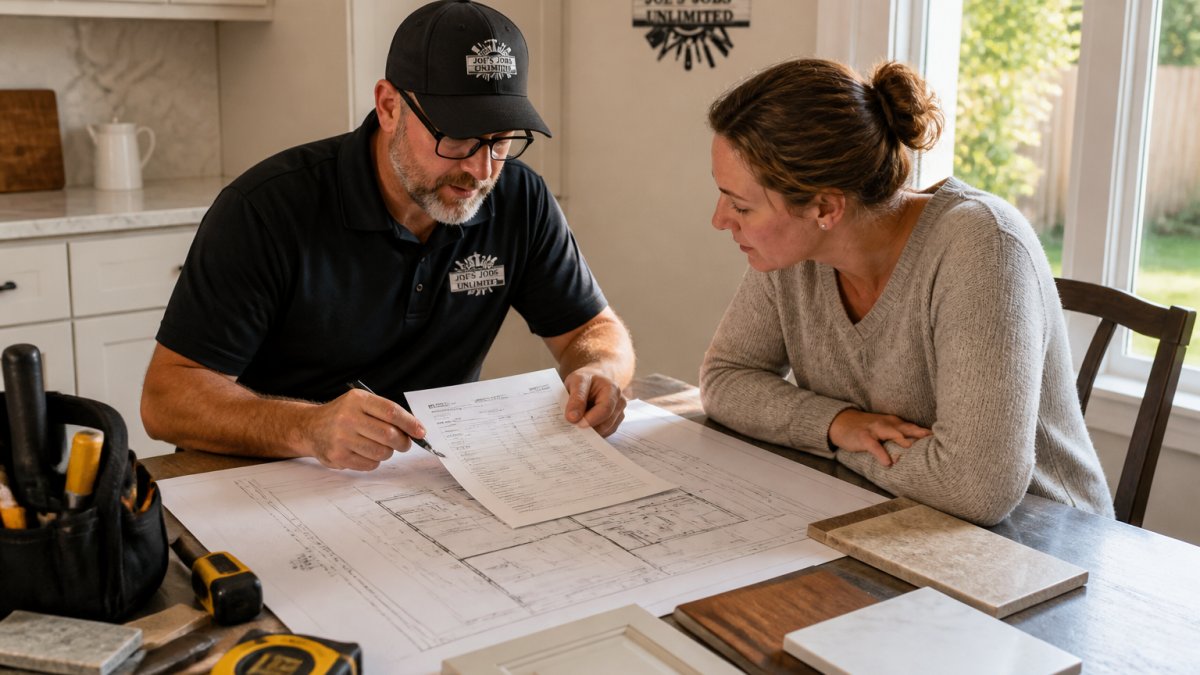
The Four Models You Are Actually Choosing Between
Most 'full service alternatives' fall into one of four structures. Compare them on the same criteria before you compare price.
| Model | Who holds the contract | Who pulls permits | Who carries scheduling risk | Typical fee structure | Best fit |
|---|---|---|---|---|---|
| Full-service general contractor | You sign one agreement | The GC, in their name | The GC | Markup on labor and materials, or a flat management fee | Kitchens, baths, additions, multi-trade work |
| Design-build firm | You sign one agreement | The firm | The firm | Bundled design + construction fee | Projects where design and build must stay in sync |
| Owner-as-general-contractor | You sign each trade separately | You, as the homeowner | You | You pay trades directly; no coordination markup | Confident DIY managers with time to supervise |
| Specialty trade direct | You sign with one trade | That trade, for their scope only | You, across all other trades | Hourly or per-task | Single-system work (electrical panel, HVAC swap) |
Homeowners often underestimate the owner-as-GC model. You save the coordination markup but absorb the schedule risk, inspection scheduling, and change-order disputes between trades. On a two-week bathroom that is manageable; on a kitchen with a layout change, it is a part-time job.
What Actually Drives the Number
Cost on a kitchen or bath is driven by five variables, roughly in this order:
- Layout changes. Moving a drain, supply line, or gas line triggers plumbing and sometimes structural work. Keeping fixtures in place is the biggest cost lever.
- Structural work behind the walls. Rot, undersized framing, or a load-bearing wall that has to come out, invisible until demolition.
- Material tier. Cabinet boxes, countertops, tile, and fixtures span a wide range. Specifying by brand and grade makes bids comparable.
- Permit and inspection scope. A like-for-like swap may not need a permit; a layout change usually does. Fees and inspection scheduling add cost and time.
- Contingency. It is commonly advised to hold a contingency for hidden conditions. Opening a wall is when the real numbers appear.
Because these variables swing widely by region, materials, and scope, no honest article can give a single national number. What you can do is force every bid onto the same scope so the comparison is real.
How to Read a Fee Structure
Full-service firms typically price three ways: a percentage markup on labor and materials, a flat project management fee, or cost-plus, where you see invoices plus an agreed percentage. Each shifts risk differently. A flat fee protects you if the project runs long; cost-plus protects the contractor. Neither is wrong, but know which you are signing, and what happens to the fee if scope grows.
A Criteria-Based Comparison You Can Run Yourself
Before you pick a model, score each option on the same five criteria:
- Service scope: Does the provider handle every trade your project needs, or will you still be hiring someone?
- Location and coverage: Do they actually work in your area, and can they pull permits in your jurisdiction?
- Project fit: Have they completed projects of your size and type, not just similar-looking photos?
Score each alternative on those five, and the 'cheapest' option often stops looking cheapest.
Questions to Ask a Contractor Before Signing
The right questions to ask a contractor reveal whether they can deliver. Anyone can promise a beautiful kitchen; fewer can explain their permit process, change-order policy, and who shows up on day one.
Ask these before you sign anything:
- Who is my single point of contact for the whole project?
- Which trades do you handle in-house, and which do you subcontract?
- How do you handle unexpected structural issues once work begins?
Joe's Jobs Unlimited handles remodeling, kitchen and bath work, drywall, tile, cabinets, and carpentry under one roof, so homeowners are not chasing five different crews. That is the difference between a comprehensive service and a fragmented approach.
Contractor Estimate Comparison: Reading Bids Side by Side
A contractor estimate comparison only works when bids describe the same scope. If one bid includes permit fees and another excludes them, the cheaper number is an illusion.
Line up every estimate against the same checklist:
- Scope of work, written in plain language
- Materials specified by brand and grade
- Permit responsibility stated clearly
The Federal Trade Commission guidance on home improvement contracts notes that you should never sign a contract with blank spaces or missing terms. If a bid is vague, treat that vagueness as a warning.
Home Improvement Contract Checklist for Protected Projects
A home improvement contract checklist protects your money and timeline. Before signing, confirm every item below is in writing.
- Contractor name, address, and license number
- Detailed scope of work with materials listed
- Total price and payment schedule
Many states require a written right to cancel within a set window for home solicitation contracts. Because rules vary, check your state's consumer protection office for the requirements that apply to you.
Licensing, Insurance, and Permit Due Diligence
Due diligence means verifying three things before work starts: license, insurance, and permits. Skipping this step is how homeowners end up liable for injuries or failed inspections. The difference between 'I asked' and 'I verified' is the point.
Licensing: Verify, Do Not Photocopy
A license number on a business card proves nothing. Verify it through your state's licensing board or online lookup.
Licensing rules are state-specific. Some states license general contractors; others license only specialty trades and leave residential remodeling largely unregulated. That is why 'check your state board' is not a dodge, it is the answer, and it changes what you should ask for.
Insurance: Read the Certificate, Then Call
Ask for a certificate of insurance showing two coverages:
- General liability, covers property damage and third-party injury on the job.
- Workers' compensation, covers injuries to workers on your property.
The certificate is a snapshot, not proof, it can be issued and then lapse. Call the insurer listed and confirm the policy is active and the dates cover your project window. If a contractor cannot produce a certificate, or the insurer cannot confirm coverage, that is your answer.
Permits: Who Pulls Them, and Why It Matters
Permitted work must be inspected, and the permit is a public record tying the work to a licensed party. Settle two questions in writing before work starts:
- Who pulls the permit? If the contractor pulls it, the inspections are their responsibility. If you pull it as the homeowner, you own the inspection schedule and any correction notices.
- What scope does the permit cover? A permit for a cosmetic refresh does not cover a layout change. Confirm the permit matches the actual work.
If a contractor suggests skipping the permit to save time or money, walk away. Unpermitted work can complicate a future sale, may need to be torn out, and can void insurance claims tied to the work.
The Pre-Signing Due Diligence Checklist
Run this before you sign, not after:
- License number verified through the state board, current, and in the contracting entity's name
- General liability certificate obtained, insurer called, coverage confirmed active
- Workers' compensation certificate obtained and confirmed
- Permit responsibility stated in the contract
The Federal Trade Commission guidance on home improvement contracts notes that you should never sign a contract with blank spaces or missing terms. Many states also require a written right to cancel within a set window for home solicitation contracts; because those rules vary, check your state's consumer protection office for the specific requirements that apply to you.
Conclusion: Choosing the Right Full Service Contractor
Choosing well comes down to verification, not sales pitches. Check the license, confirm the insurance, read the contract, and compare bids against the same scope.
Joe's Jobs Unlimited handles remodeling, kitchen and bath projects, drywall, tile, cabinets, and carpentry as one coordinated service, so you are not managing five schedules yourself.
Get started with Joe's Jobs Unlimited and keep your next renovation on schedule, on scope, and under one roof.
Frequently Asked Questions
What should I look for in an alternative to a full-service home improvement company?
Look for a contractor who holds the right state license, carries general liability and workers' compensation insurance, and provides a written estimate with line-item scope. Ask whether all trades are handled in-house or subcontracted, how change orders are priced, and who manages the schedule. Request references from projects similar in size to yours and confirm the contractor's service area covers your location before you sign anything.
Should I hire a handyman or a general contractor for my project?
A handyman suits small repairs, painting, and minor carpentry that typically fall under a lower licensing threshold. A general contractor is the better choice for kitchen remodeling, bathroom remodeling, home additions, or any project that requires permits, structural work, or multiple trades. If your project needs electrical, plumbing, or HVAC changes, a licensed contractor should coordinate those trades and pull the permits.
How do I compare contractor estimates fairly?
Match each bid against the same scope of work. Check whether the estimate lists materials by brand and grade, includes permit fees, and states what happens if hidden damage is found. A lower number often means excluded items, not savings. Ask each contractor to itemize labor and materials separately, then compare totals line by line rather than on the bottom-line price alone.
What questions should I ask before hiring a contractor?
Ask for the license number and verify it with your state licensing board. Confirm insurance coverage and request certificates. Ask how many projects the contractor runs at once, who will be on site daily, and how schedule changes are communicated. Get written answers on payment schedule, warranty terms, and change-order pricing. A contractor who answers these in writing before the contract is a stronger candidate.
When does a remodeling project require a licensed specialist?
Most states require a licensed electrician for panel work, new circuits, and any wiring behind walls. Plumbing that alters supply or drain lines typically requires a licensed plumber, and HVAC changes usually need a licensed mechanical contractor. Structural alterations, room additions, and most kitchen and bath remodels need permits, which means a licensed contractor must pull them. Confirm the rules with your local building department before work starts.