blog
Flintrock Construction vs PowerHRG: What Homeowners Need to Know
Joe Daugherty · 10/5/2026 · 14 min read
Table of Contents
- Flintrock Construction vs PowerHRG: A Direct Comparison
- Service Offerings and Project Scope
- How to Compare Home Improvement Contractor Quotes
- Questions to Ask a Contractor Before Hiring
- Contractor License and Insurance Checklist
- Home Improvement Contract Checklist
- New Construction vs Home Remodeling: Which Contractor Fits Your Needs
- Warranty Coverage and Complaint Resolution
- Frequently Asked Questions
Last Updated: October 5, 2026
Flintrock Construction vs PowerHRG: A Direct Comparison
Choosing between contractors like flintrock construction vs powerhrg can make or break a major renovation. At Joe's Jobs Unlimited, we know homeowners need clear guidance on evaluating contractors. The question isn't which company has the best reputation, but whether their service model, experience, and approach match your project.
Flintrock Construction and PowerHRG represent two philosophies: one focuses on new construction and large-scale residential projects, the other on remodeling and renovation. Understanding these distinctions helps you determine which contractor aligns with your needs.
The real challenge isn't finding contractors, it's comparing them fairly. This guide covers the factors that separate a good choice from a costly mistake.
Service Offerings and Project Scope
Before comparing these two names, confirm what each actually does, search results suggest they are not direct substitutes.
Verify it yourself: open each company's website and check the services page, a project gallery with addresses or neighborhoods, and a current license record. A builder shows site prep, foundation, framing, and dried-in photos; a remodeler shows before-and-after photos of kitchens, baths, and exteriors.
Here is how the two project categories differ in practice:
| Factor | New construction | Remodeling / renovation |
|---|---|---|
| Starting point | Raw lot or cleared site | Existing structure with unknown conditions |
| Site work | Grading, utilities, foundation, framing | Demolition, protection of finished areas |
| Sequencing | Long, linear, weather-dependent | Phased around an occupied home |
| Biggest cost driver | Square footage, site conditions, finishes | Hidden conditions behind walls, scope changes |
| Typical duration | Many months for a single-family home | Weeks to a few months per room or system |
| Permit type | Building permit for new structure | Trade and alteration permits |
| Main risk | Schedule and financing carry | Discovery of rot, wiring, or plumbing problems |
A crew optimized for one category isn't automatically optimized for the other. A builder running large framing crews may not be set up to protect floors, contain dust, and finish a bathroom in weeks.
The practical test isn't "which company is better" but "which has documented, recent, local experience with my exact project." Ask for:
- A list of completed projects in the same category as yours, with dates.
- The name of the permit-issuing jurisdiction for each project, so you can verify permits were pulled.
- The name of the person who will run your job day to day, not just the salesperson.
- Whether the company self-performs the core work or subcontracts it, and which trades are subbed.
A new home means comparing builders. A kitchen, bath, addition, or exterior renovation means comparing remodelers.
"Custom home design and construction" and "remodeling" are often marketed with the same words, custom, high-end, turnkey, but delivered by different business models. A design-build new-construction firm typically carries a designer, project manager, and superintendent; a remodeling firm often runs smaller crews and relies more on the homeowner to make selections on a compressed timeline. Ask which model you're buying into before comparing price.
How to Compare Home Improvement Contractor Quotes
Getting multiple quotes is standard, but comparing them properly requires more than the bottom-line number. A written quote should break down costs by category, materials, labor, permits, specialized work, revealing whether contractors are pricing similarly or one is significantly under or overpriced.
When you receive a quote, look for these components:
- Materials list with specific product names and quantities
- Labor costs broken down by trade or phase
- Timeline with start and completion dates
- Payment schedule showing when money is due
- Warranty details on workmanship and materials
- Allowances for items you haven't finalized yet
A vague quote lumping everything into one number is a red flag, the contractor either hasn't thought the project through or is hiding something. Experienced contractors provide detailed quotes because clarity prevents disputes later.
When comparing quotes, adjust for scope differences: one contractor might include permit costs while another doesn't, or include a warranty on tile work while another limits it to labor only. These differences affect the true cost of each proposal.
Questions to Ask a Contractor Before Hiring
Before signing a contract, get answers to questions that reveal how a contractor operates and whether they'll handle your project professionally.
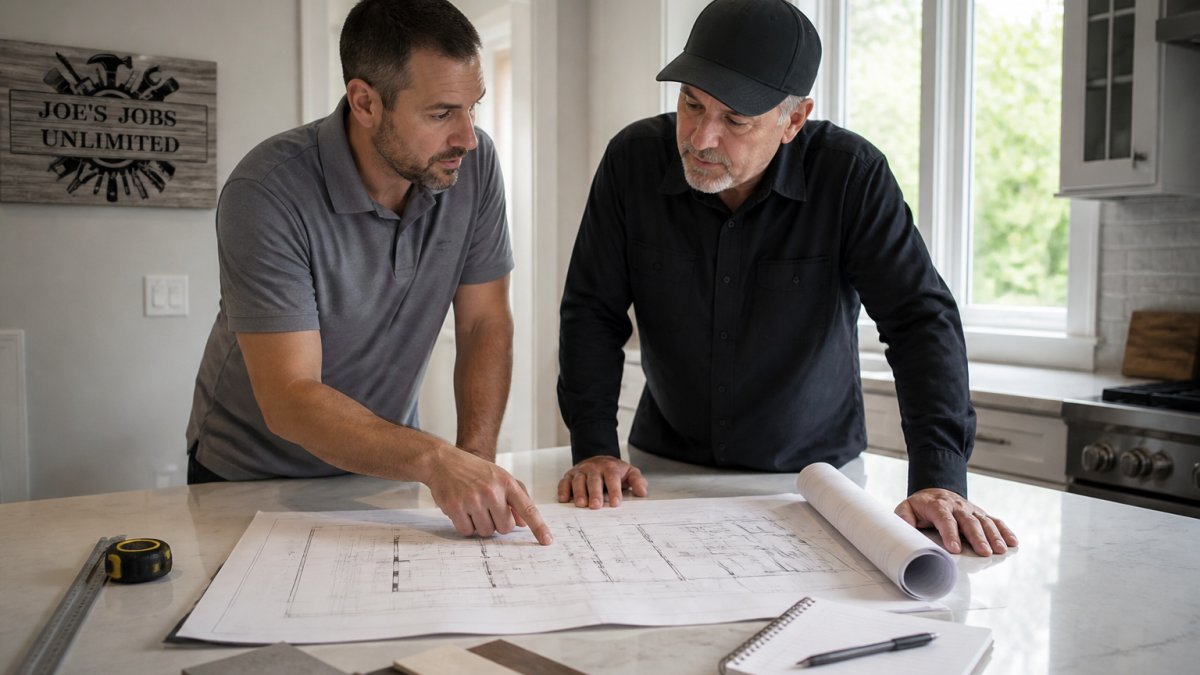
Ask every contractor these questions:
- How long have you been in business, and what's your experience with projects like mine?
- Can you provide references from customers in my area who've completed similar work?
- What's your process if we discover structural issues or unexpected problems during the project?
- How do you handle communication? How often will I hear updates, and who's my main point of contact?
- What's your timeline for this project, and what happens if it runs over?
- Are you licensed and insured? Can you provide proof of both?
- What warranty do you offer on workmanship, and how long does it last?
- What percentage of payment is due upfront, and what's the payment schedule?
The answers reveal whether a contractor has systems in place. One in business for years with solid references has a track record; one who explains their process for handling surprises has learned from experience; one who specifies communication frequency understands homeowners worry about project status.
Contractor License and Insurance Checklist
This is non-negotiable: verify any contractor you hire is properly licensed and insured. Licensing requirements vary by state and work type, but a licensed contractor has met training standards and is accountable to a regulatory body.
Request proof of:
- Current state contractor license (verify the license number with your state's licensing board)
- General liability insurance (minimum coverage of $1 million)
- Workers' compensation insurance (required if the contractor has employees)
- Bonding (protects you if the contractor fails to complete work or pay suppliers)
A contractor who hesitates to provide these documents is one to avoid. Licensed, insured contractors carry these credentials because they're required and protect both parties. If someone gets injured on your property, the contractor's insurance covers it, not your homeowner's policy.
Check your state's licensing board website to verify the license is current and active. Some states maintain complaint histories. A few complaints might be normal for a contractor handling dozens of projects yearly, but a pattern of unresolved complaints is a warning sign.
Home Improvement Contract Checklist
A written contract protects both you and the contractor, specifying what work will be done, what it costs, when it starts and ends, and what happens if something goes wrong. Never hire a contractor without one.
Your contract should include:
- Scope of work, detailed description of exactly what will be built or remodeled
- Materials specifications, brand names and quality grades for major materials
- Total price and payment schedule with specific dates
- Start and completion dates with any penalties for delays
- Change order process, how you'll handle additions or changes to the original scope
- Warranty terms, what's covered and for how long
- Cleanup and final walkthrough, when the contractor removes debris and shows you finished work
- Dispute resolution, how you'll handle disagreements (mediation, arbitration, or court)
The contract is your protection if the project goes sideways: it specifies what "finished" looks like, defines the payment schedule so you're not funding everything upfront with no recourse, and includes a change order process so additions don't spiral into budget disasters.
A contractor who resists putting terms in writing is someone to avoid. Professional contractors expect contracts, they protect them too by clarifying expectations upfront.
New Construction vs Home Remodeling: Which Contractor Fits Your Needs
These are fundamentally different projects requiring different expertise. New construction means building on raw land or an empty lot, managing site prep, foundation, framing, roofing, and all interior systems from scratch.
Home remodeling means renovating an existing structure, working around existing walls, plumbing, electrical, and HVAC.
The skill sets overlap but aren't identical. A new construction contractor coordinates large crews and long timelines; a remodeling contractor works in tight spaces, minimizes disruption, and handles surprises.
Building a new home requires a contractor experienced in new construction with references from similar projects. Remodeling a kitchen or bathroom requires remodeling experience and completed renovation work in your area.
Joe's Jobs Unlimited offers comprehensive contractor services, providing professional and reliable solutions for all your home improvement needs.
Warranty Coverage and Complaint Resolution
Warranty language is where contractor marketing and obligations diverge most sharply. Do not accept a verbal warranty. Ask for the written warranty document, not the contract, the separate warranty, and read it before signing anything.
When you read a workmanship warranty, look for these specific terms:
- Duration and start date. Does coverage begin at substantial completion, at final payment, or at the date on the permit? The start date changes how much coverage you actually have.
- What is excluded. Common exclusions include homeowner-supplied materials, damage from neglect, normal settlement, and work performed by other contractors after the project closes.
- Transferability. If you sell the home, does the warranty transfer to the buyer? A transferable warranty is a resale asset; a non-transferable one is not.
- Response obligations. Does the warranty state how quickly the contractor must respond to a claim? A warranty with no response timeline is a promise without a mechanism.
- Remedy. Does the contractor repair, replace, or refund? These are very different outcomes.
- Consequential damages. Most warranties exclude them. That means if a failed shower pan damages the floor below, the warranty may cover the pan and not the floor.
Manufacturer warranties are separate from workmanship warranties and usually registered by the contractor at installation. Ask for the registration confirmation and model and serial numbers of major installed products, appliances, water heaters, HVAC equipment, roofing, windows.
On complaint resolution, check primary sources rather than review snippets:
- State or local licensing board. Search the contractor's license number and look for disciplinary actions, not just status. A current license with an open complaint is different from a clean record.
- Better Business Bureau profile. Look at the number of complaints, how many were closed in the last three years, and whether the business responded. Volume matters less than pattern.
- State attorney general or consumer protection office. Some publish actions against home improvement contractors.
- Court records. A search of the county where the company is based can reveal lawsuits, liens, or judgments.
- Review platforms. Read the one- and two-star reviews specifically. Recurring complaints about the same issue, scheduling, change orders, punch lists, are more informative than a single angry post.
When comparing two contractors, ask each the same four questions and write down the answers:
- Can you send me your written workmanship warranty before I sign?
- What is your process when a homeowner reports a defect after final payment?
- Who is my point of contact for warranty claims, and what is the expected response time?
- Have you had any licensing board complaints in the last five years, and how were they resolved?
A contractor who answers directly is telling you how the relationship will go after the last check clears.
Finally, understand your leverage.
Frequently Asked Questions
How do I compare home improvement contractor quotes from different providers?
Request written quotes from at least three contractors that include itemized labor and materials costs, project timeline, payment schedule, and warranty terms. Ensure all quotes cover the same scope of work so you're comparing apples to apples. Don't select based on price alone, verify licensing, insurance, references, and customer reviews. A detailed quote protects you from hidden costs and scope creep.
What should I verify before hiring a contractor?
Check that the contractor holds a valid state license, carries liability insurance and workers' compensation coverage, and can provide references from recent projects. Ask about their experience with your specific project type, kitchen remodeling, bathroom renovation, or electrical work. Review online ratings and BBB accreditation. Request a written contract that includes the project scope, timeline, payment terms, and warranty coverage before work begins.
What's the difference between Flintrock Construction and PowerHRG?
Flintrock Construction and PowerHRG have different project specializations. Contact each directly for details on their specific service areas, available customization options, warranty terms, and whether they handle your project type.
Should I hire a contractor for new construction or home remodeling?
For kitchen or bathroom updates, deck installation, or siding replacement, hire a remodeling contractor with proven experience in that specific project type. Ask about their portfolio and completed projects that match your needs before committing.